Wind turbines in a green field under a blue sky with clouds.

Our Commitment

Shared coordination, accountability and strategic vision in support of sustainability.

The Governance that guides our action

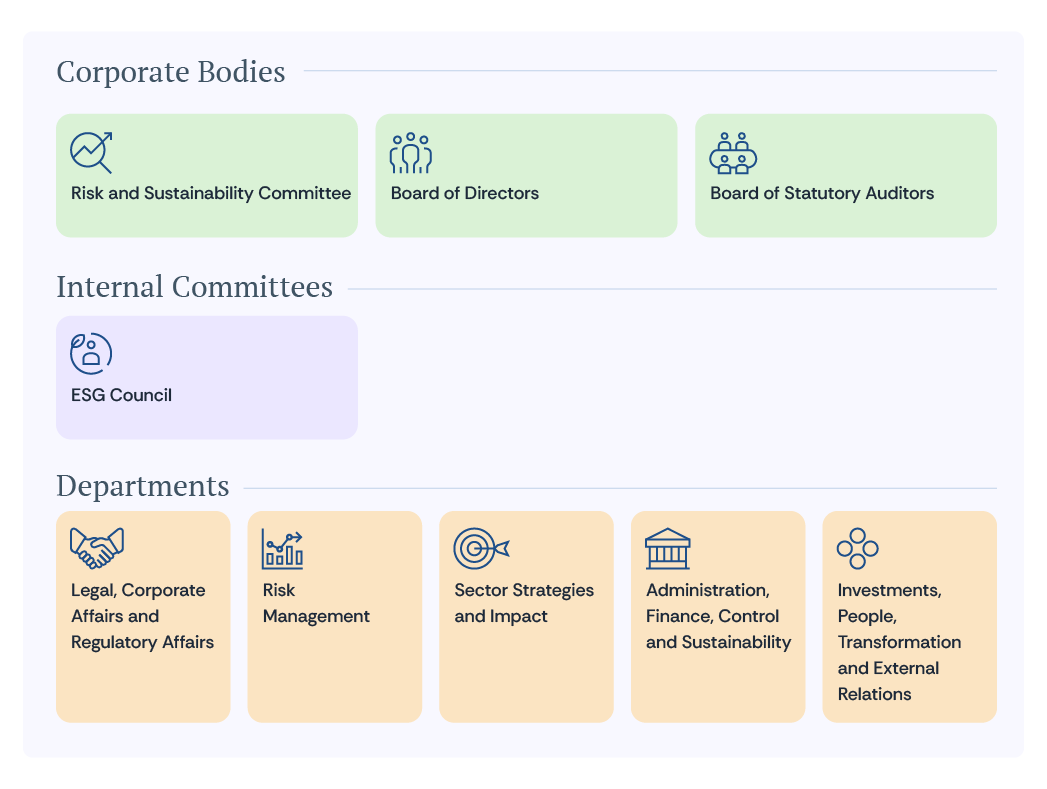
Sustainability is integrated into the Group's decision-making and operational processes. The Board of Directors defines the ESG strategic direction, while the ESG Council, chaired by the chief executive officer, ensures cross-functional coordination on key sustainability initiatives through regular oversight and engagement. The Group's business units are responsible for implementation through policies and tools embedded within business activities. Sustainability representatives appointed within each business unit oversee relevant sustainability topics and ensure coordination across activities.

A common framework of policies

As a policy-driven institution, our approach to sustainability is guided by a framework of policies that support the integration of sustainability considerations into decision-making processes, business activities and internal operations. These tools define principles, responsibilities and operating procedures, helping to make our strategy tangible, consistent and effective over time.


Document
Description
Sustainability Framework Regulations Describes the guiding and methodological principles, the areas and the operating methods that CDP adopts and implements in managing sustainability within its organisational system, in compliance with external regulation and associated internal rules.
General Policy for Responsible Financing Guides business activities aimed at generating positive and measurable impacts in the field of ESG.
General Policy for Responsible Investing Defines the guiding principles of direct and indirect investments based on ESG criteria.
General Stakeholder Engagement Policy The document identifies ways of listening and dialogue for constant involvement of stakeholders in order to establish concrete collaboration and produce shared value.
Diversity, Equity and Inclusion Policy Sets out the guiding principles and operating methods to promote the values of diversity, equity and inclusion among internal and external stakeholders, with measures in four macro areas: people, business, purchasing and communication.
General Well-being Policy It defines CDP's commitment to guaranteeing a positive, fair and stimulating working environment, through the adoption of principles and initiatives aimed at its people, to promote their work-life balance and consequent psycho-physical well-being.
Energy Sector Policy It outlines where we do and don’t make interventions in terms of our financing and investment activities in the energy sector; it also aims to integrate ESG aspects as part of business processes, identify criteria for the handling of areas to be promoted in line with the Strategic Guidelines developed for the sector and define the criteria governing limitations and exclusions.
Defence and Security Sector Policy Establishing treatment, limitation and exclusion criteria to guide CDP's operations in the defence and security sector.
Transport Sector Policy It defines treatment, limitation and exclusion criteria to guide CDP's operations in the transport sector, relating to the building of infrastructure, the construction of vehicles (excluding the production of parts) and the provision of services for road transport, rail transport and fixed installations, transport by sea and inland waterways, and air transport.
Agrifood, Wood and Paper Industries sector Policy It establishes limitation, exclusion criteria and aspects to be promoted to guide CDP's operations in the Agrifood, Wood and Paper Industries Sector.
Stakeholder Grievance Mechanism Policy Describe the mechanism made available to the civil society in order to report current or potentially negative social/environmental impacts that may result from operations financed by CDP or from operations for which the financial support of CDP was requested within the scope of the International Cooperation and Development Finance Area (ICDF).
General Internal Footprint Policy Sets out the general principles and operating methods to promote best practices in environmental sustainability and reduce environmental impacts, with particular reference to those relating to CDP operating model, i.e. linked to the management of workplaces, ICT components and travel.
General Responsible Procurement Policy

Annex Supplier Code of Conduct
Sets out the guiding principles and operating methods to continuously promote best practices in environmental and social sustainability and good governance in CDP supply chain.
Summary Document - Tax Integrity and Transparency The document presents a concise overview of the guidelines that CDP and its Group Companies adopt to mitigate the Tax Integrity Risk associated with operations concerning the management of EU resources and other supranational funds, as well as the Risk of Tax and Financial Transparency linked to counterparties.
Tax Strategy The Tax Strategy defines the objectives, principles and guidelines adopted by CDP for managing the tax matters and the risk associated.
Integrated Policy for Environment, Occupational Health & Safety and Energy States the principles and commitments made by the company's senior management for the continuous improvement of the management systems and is circulated to all levels of the organisation.
Scope of application of the Integrated Management System for the Environment, Occupational Health and Safety and Energy Specifies the scope of application of the Integrated Environmental, Occupational Health and Safety and Energy Management System; the scope of application includes the activities, internal and external factors, the needs and expectations of the interested parties and the physical and organizational boundaries of the locations where CDP assumes the role of owner, lessor or lessee and in which CDP personnel are present.
Guidelines on Antitrust, Conflicts of Interest, Market Abuse and Privacy Summarizes - in line with the internal regulations approved by CDP’s competent bodies - the guidelines and key measures adopted by CDP in the following areas of paramount interest, considering its operational activities: Antitrust, Conflicts of Interest, Market Abuse and Privacy.
Describes the guiding and methodological principles, the areas and the operating methods that CDP adopts and implements in managing sustainability within its organisational system, in compliance with external regulation and associated internal rules.
Guides business activities aimed at generating positive and measurable impacts in the field of ESG.
Defines the guiding principles of direct and indirect investments based on ESG criteria.
The document identifies ways of listening and dialogue for constant involvement of stakeholders in order to establish concrete collaboration and produce shared value.
Sets out the guiding principles and operating methods to promote the values of diversity, equity and inclusion among internal and external stakeholders, with measures in four macro areas: people, business, purchasing and communication.
It defines CDP's commitment to guaranteeing a positive, fair and stimulating working environment, through the adoption of principles and initiatives aimed at its people, to promote their work-life balance and consequent psycho-physical well-being.
It outlines where we do and don’t make interventions in terms of our financing and investment activities in the energy sector; it also aims to integrate ESG aspects as part of business processes, identify criteria for the handling of areas to be promoted in line with the Strategic Guidelines developed for the sector and define the criteria governing limitations and exclusions.
Establishing treatment, limitation and exclusion criteria to guide CDP's operations in the defence and security sector.
It defines treatment, limitation and exclusion criteria to guide CDP's operations in the transport sector, relating to the building of infrastructure, the construction of vehicles (excluding the production of parts) and the provision of services for road transport, rail transport and fixed installations, transport by sea and inland waterways, and air transport.
It establishes limitation, exclusion criteria and aspects to be promoted to guide CDP's operations in the Agrifood, Wood and Paper Industries Sector.
Describe the mechanism made available to the civil society in order to report current or potentially negative social/environmental impacts that may result from operations financed by CDP or from operations for which the financial support of CDP was requested within the scope of the International Cooperation and Development Finance Area (ICDF).
Sets out the general principles and operating methods to promote best practices in environmental sustainability and reduce environmental impacts, with particular reference to those relating to CDP operating model, i.e. linked to the management of workplaces, ICT components and travel.
Sets out the guiding principles and operating methods to continuously promote best practices in environmental and social sustainability and good governance in CDP supply chain.
The document presents a concise overview of the guidelines that CDP and its Group Companies adopt to mitigate the Tax Integrity Risk associated with operations concerning the management of EU resources and other supranational funds, as well as the Risk of Tax and Financial Transparency linked to counterparties.
The Tax Strategy defines the objectives, principles and guidelines adopted by CDP for managing the tax matters and the risk associated.
States the principles and commitments made by the company's senior management for the continuous improvement of the management systems and is circulated to all levels of the organisation.
Specifies the scope of application of the Integrated Environmental, Occupational Health and Safety and Energy Management System; the scope of application includes the activities, internal and external factors, the needs and expectations of the interested parties and the physical and organizational boundaries of the locations where CDP assumes the role of owner, lessor or lessee and in which CDP personnel are present.
Summarizes - in line with the internal regulations approved by CDP’s competent bodies - the guidelines and key measures adopted by CDP in the following areas of paramount interest, considering its operational activities: Antitrust, Conflicts of Interest, Market Abuse and Privacy.
Highway along a valley with a turquoise-colored river.

A year of concrete results

From the impact generated across local communities to the responsible management of our operations, the results achieved during the year reflect the Group’s commitment to creating shared value and contributing to the country’s sustainable transition.

A cornfield at sunset, with sunlight filtering through green leaves.

2025 Sustainability Profile

A clear and concrete overview of how sustainability drives the CDP Group’s strategy and translates into measurable outcomes for the country and its communities. The report provides a comprehensive overview of CDP’s ESG commitment, enriched with examples of high-impact projects and initiatives.

Investing in shared value

Three people sitting at a table collaborating with a laptop, with papers and pens nearby.
People at the core

People are a fundamental driver of sustainable value creation. Skills, engagement and a shared sense of responsibility enable sustainability to be integrated into everyday activities and translated into tangible impact. 

Discover more
Museum hallway with paintings on the walls and a stone floor.
A culture that creates value

Art and culture are strategic drivers of sustainable territorial development. Their long-term value helps pass on the country's historical and artistic heritage to future generations. CDP promotes and preserves its artistic and archival heritage through its Museum, which highlights the relationship between art, business and Italy's industrial culture. 

Discover more
People walking in a plaza, viewed from above with a network of lines and points overlaid.
CDP Foundation

Fondazione CDP supports the Third Sector by promoting social inclusion, education, research and culture for the development of communities. 

Discover more
Outdoor celebration in a plaza with children and colorful balloons in front of a historic building.
Impact Ambassadors

We promote corporate volunteering initiatives that actively engage our people, giving them the opportunity to contribute directly to the social and environmental development of local communities.

Scopri di più